
Quote List
No Products Selected Yet
⸻
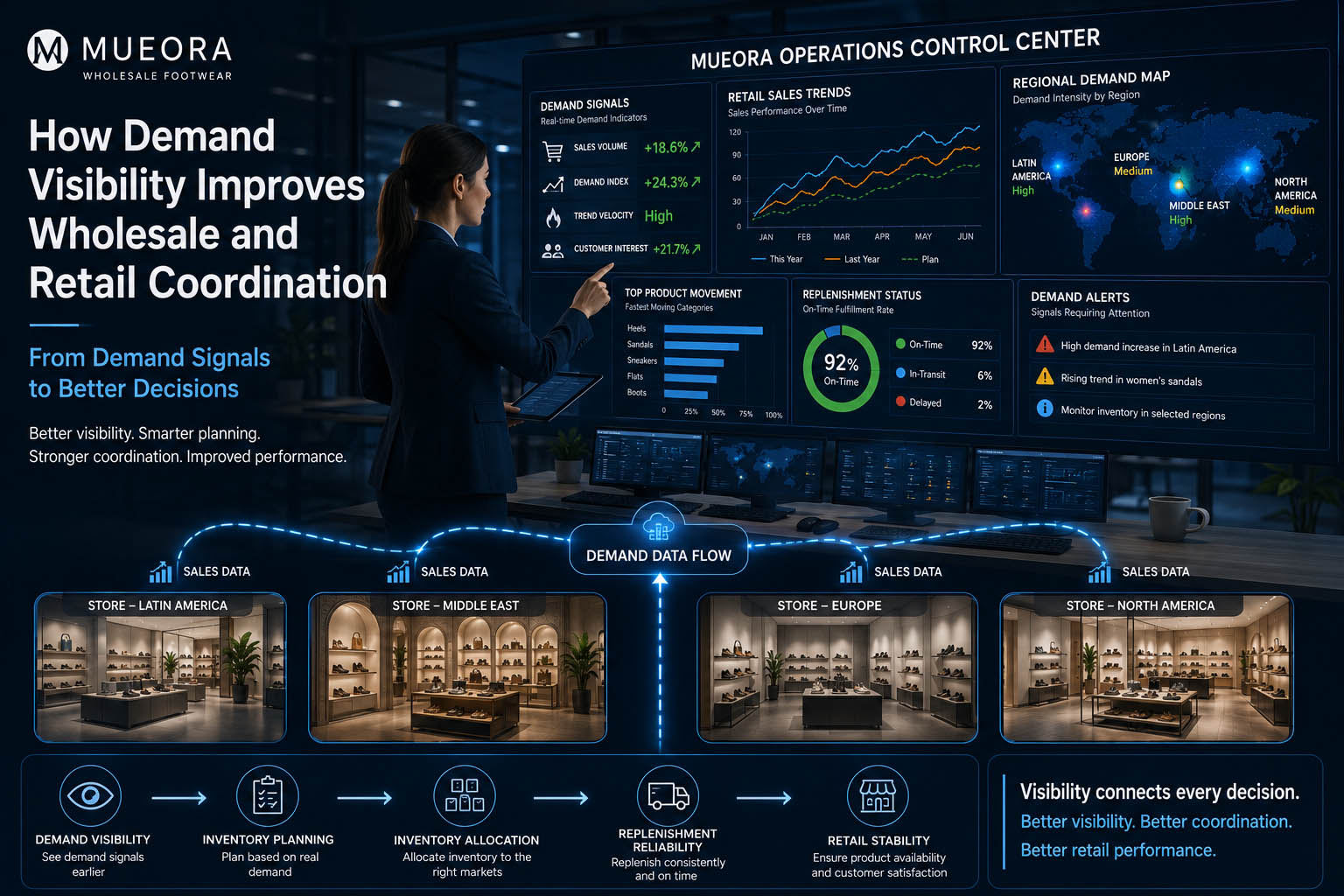
How Demand Visibility Improves Wholesale and Retail Coordination
In footwear wholesale and retail operations, effective coordination depends on accurate information.
As markets become more dynamic, businesses face increasing challenges in understanding where demand is emerging, how quickly it is changing, and what actions are required to respond effectively.
Without visibility, coordination becomes difficult.
Inventory decisions become less accurate, replenishment cycles become less efficient, and operational stability becomes harder to maintain.
In modern footwear markets, demand visibility has become a critical foundation for coordination.
⸻
Why Visibility Matters in Modern Retail
Consumer demand is evolving more rapidly than ever before.
Several factors contribute to this shift:
• emotional consumption patterns
• shorter trend cycles
• faster information flow
• changing regional preferences
• increasing demand variability
Under these conditions, relying solely on historical sales data is no longer sufficient.
Businesses need greater visibility into current and emerging demand conditions.
Visibility enables organizations to understand market changes earlier and respond more effectively.
⸻
The Cost of Limited Demand Visibility
When demand visibility is limited, operational inefficiencies often emerge.
Common challenges include:
• excess inventory accumulation
• unexpected stock shortages
• inaccurate inventory allocation
• delayed replenishment decisions
• reduced responsiveness to market changes
Without clear demand signals, wholesale and retail operations may become disconnected from actual market conditions.
This increases operational risk and reduces efficiency throughout the supply chain.
⸻
What Demand Visibility Means
Demand visibility refers to the ability to identify, monitor, and understand demand patterns across different markets and sales channels.
Key sources of visibility include:
• retail sales performance
• inventory movement data
• replenishment activity
• regional demand trends
• customer purchasing behavior
When these signals are integrated effectively, businesses gain a more complete understanding of market conditions.
This allows for better operational decision-making.
⸻
How Visibility Improves Inventory Planning
Inventory planning becomes significantly more effective when supported by demand visibility.
With stronger visibility, businesses can:
• forecast inventory requirements more accurately
• reduce stock imbalances
• improve inventory allocation decisions
• support more efficient replenishment cycles
• reduce inventory-related risk
Rather than relying solely on assumptions, inventory planning becomes more closely aligned with actual market demand.
⸻
Improving Coordination Between Wholesale and Retail
Demand visibility creates stronger alignment between wholesale operations and retail execution.
When both sides have access to reliable demand information:
• communication improves
• replenishment decisions become faster
• inventory positioning becomes more accurate
• operational priorities become clearer
• response times improve across the supply chain
This coordination supports more stable and efficient operations.
⸻
Demand Visibility and Replenishment Reliability
Reliable replenishment depends heavily on accurate demand information.
Without visibility, replenishment decisions often become reactive.
With visibility, businesses can:
• anticipate demand changes earlier
• adjust replenishment schedules proactively
• improve inventory flow continuity
• reduce supply disruptions
• support retail product availability
Demand visibility therefore strengthens replenishment reliability across the entire system.
⸻
Visibility as a Competitive Advantage
In modern footwear markets, competitive advantage increasingly depends on how quickly businesses can identify and respond to demand changes.
Organizations with strong demand visibility are better positioned to:
• recognize emerging trends
• improve operational agility
• reduce uncertainty
• allocate resources more effectively
• maintain market responsiveness
Visibility transforms information into operational advantage.
⸻
Building More Resilient Retail Systems
As market complexity continues to increase, businesses require systems capable of adapting to change without sacrificing stability.
Demand visibility helps organizations:
• improve coordination
• strengthen planning accuracy
• enhance supply continuity
• reduce operational friction
• support long-term growth objectives
Visibility creates the foundation for more resilient wholesale and retail systems.
⸻
Conclusion
In modern footwear markets, operational efficiency begins with visibility.
Businesses cannot effectively coordinate what they cannot see.
By improving demand visibility, wholesale and retail organizations can strengthen inventory planning, enhance replenishment reliability, and improve overall operational coordination.
As consumer demand becomes increasingly dynamic, visibility is becoming one of the most valuable capabilities in modern retail operations.