Quote List
No Products Selected Yet
⸻
Why Retailers Increasingly Value Supply Systems Over Single Products
In footwear retail, product success has traditionally been associated with strong individual items.
Popular styles, seasonal trends, and fast-selling products were often viewed as the primary drivers of retail performance.
However, modern retail markets are changing.
As trend cycles accelerate and demand becomes increasingly volatile, retailers are beginning to recognize that long-term success depends on more than isolated product performance.
It depends on the reliability of the wholesale system behind it.
⸻
The Shortening Lifecycle of Product Trends
In modern consumer markets, trends move faster than ever.
Social media acceleration, emotional consumption, and rapidly shifting preferences are shortening product lifecycles across the footwear industry.
As a result:
• demand patterns change more quickly
• bestseller cycles become shorter
• purchasing behavior becomes less predictable
• inventory risk increases
Under these conditions, relying heavily on a small number of products creates growing instability for retailers.
⸻
The Risks of Product-Dependent Retail Models
Retail systems centered around isolated bestselling products often face operational challenges.
When a product loses momentum unexpectedly, retailers may experience:
• excess inventory accumulation
• unstable replenishment planning
• inconsistent sales performance
• difficulty adapting to new trends
• supply coordination inefficiencies
In volatile markets, short-term product success does not always translate into long-term operational stability.
⸻
Why Retailers Are Prioritizing Supply Systems
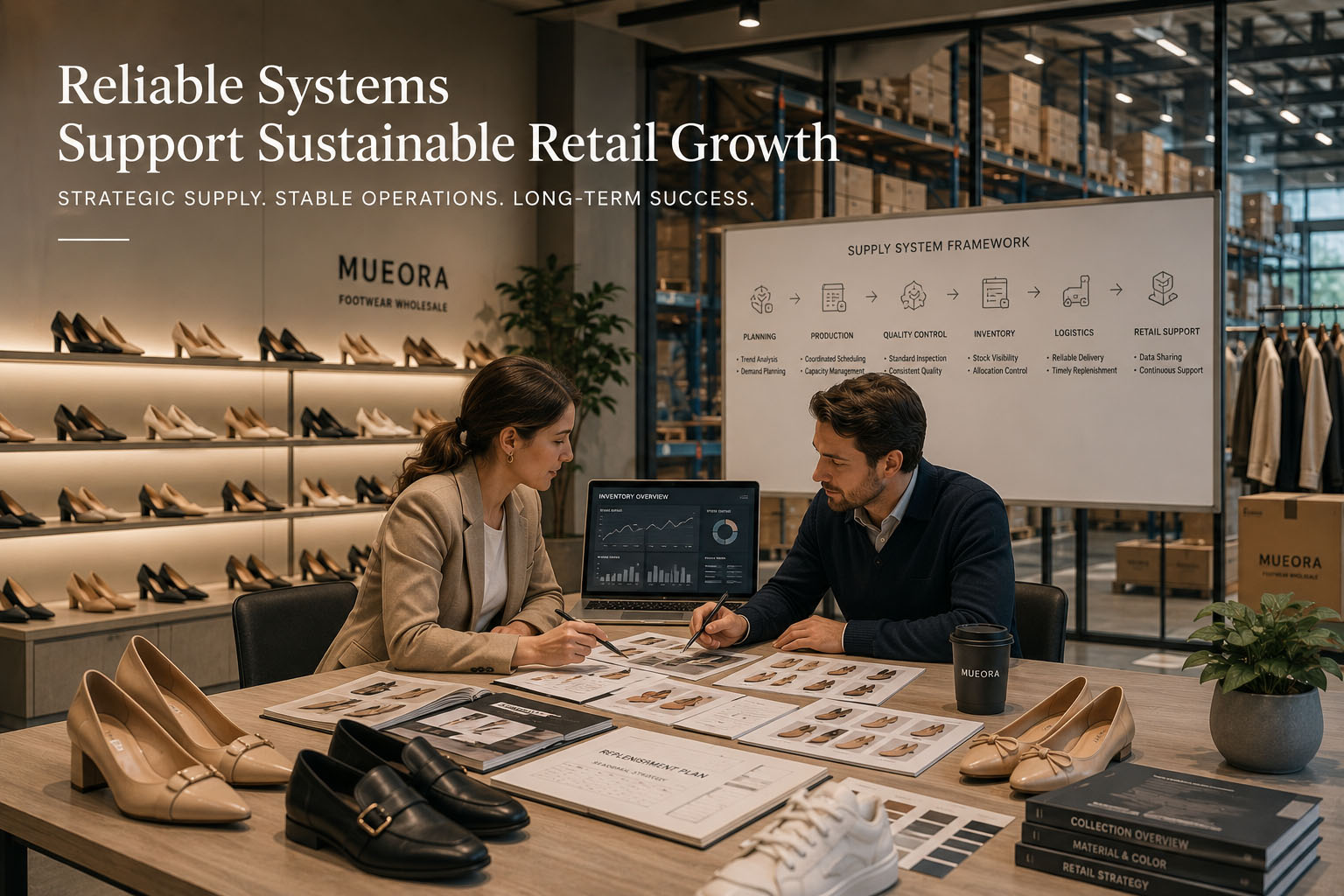
As markets become more dynamic, retailers increasingly value systems that provide continuity and coordination.
Stable wholesale systems support:
• predictable replenishment cycles
• consistent inventory flow
• flexible SKU coordination
• faster response to market changes
• reduced operational disruption
Rather than depending on isolated products, retailers seek systems capable of supporting ongoing operational stability.
⸻
From Product Transactions to System Reliability
In modern footwear wholesale, competitive advantage is increasingly shifting from individual products toward operational reliability.
Retailers now evaluate wholesale partners based on:
• supply continuity
• inventory coordination
• replenishment consistency
• responsiveness to changing demand
• operational adaptability
This represents a structural shift from transactional sourcing toward long-term system collaboration.
⸻
Structured Wholesale Systems and Retail Flexibility
Stable wholesale systems help retailers remain flexible without sacrificing control.
When operations are coordinated through structured systems:
• retailers can adjust product mixes more efficiently
• replenishment becomes more responsive
• inventory allocation improves across regions
• trend adaptation becomes more manageable
Flexibility becomes integrated into the system rather than dependent on reactive decisions.
⸻
System Stability in Emotion-Driven Markets
Emotion-driven consumer behavior increases market variability.
Demand fluctuations become more frequent, and trend cycles become harder to predict.
In this environment, retailers increasingly rely on wholesale systems capable of maintaining stability despite changing demand conditions.
Structured systems help retailers:
• reduce inventory volatility
• maintain continuity across sales cycles
• respond more effectively to rapid market shifts
• stabilize long-term retail operations
System reliability becomes a strategic asset.
⸻
Long-Term Retail Competitiveness
Retail competitiveness is no longer determined solely by product selection.
It is increasingly influenced by operational consistency and supply reliability.
Retailers supported by stable wholesale systems are better positioned to:
• maintain customer confidence
• improve operational predictability
• reduce disruption risk
• sustain long-term growth
In modern footwear retail, reliability creates competitive advantage.
⸻
Conclusion
In global footwear markets, retailers are increasingly recognizing that long-term success depends on more than individual products.
As trends become shorter and demand more volatile, stable wholesale systems provide the continuity, flexibility, and coordination required for sustainable retail operations.
In modern retail environments, system reliability is becoming more valuable than isolated product success.
⸻