
Cart
Your shopping cart doesn't have any products yet!
⸻
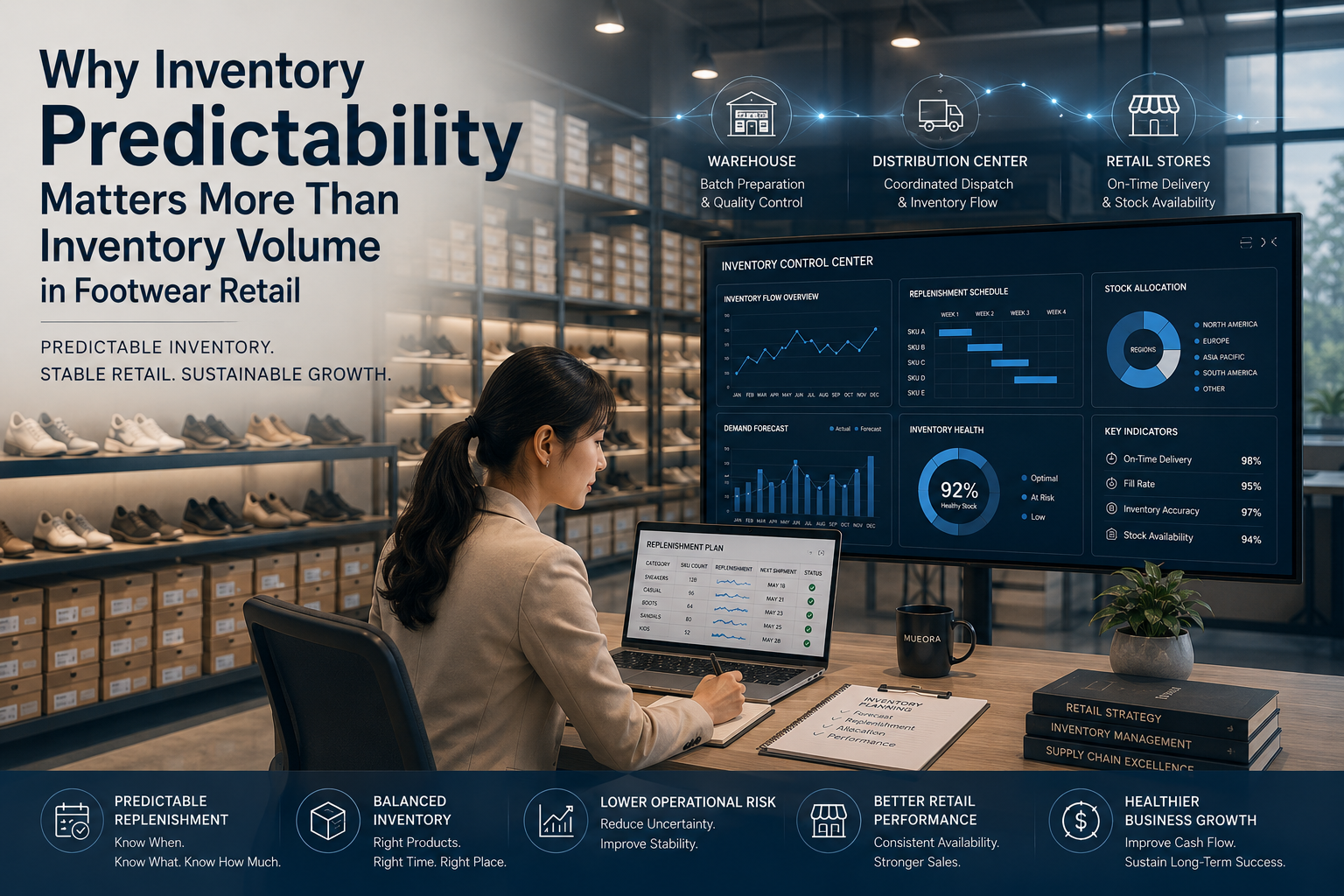
Why Inventory Predictability Matters More Than Inventory Volume in Footwear Retail
In footwear retail, inventory has long been associated with stability.
The common assumption is simple:
More inventory means more security.
Larger inventories are often viewed as a safeguard against uncertainty, stock shortages, and market fluctuations.
However, modern retail environments are changing.
As demand becomes more dynamic, trend cycles become shorter, and consumer behavior becomes less predictable, inventory volume alone is no longer the primary source of retail stability.
Predictability is becoming more important.
⸻
The Traditional Focus on Inventory Volume
Historically, many retailers viewed inventory accumulation as a strategic advantage.
Maintaining large inventory reserves was intended to:
• reduce stock-out risk
• support sales continuity
• improve order fulfillment capability
• provide flexibility during supply disruptions
In relatively stable markets, this approach often proved effective.
However, market conditions have evolved.
⸻
The Hidden Risks of Excess Inventory
Large inventory volumes do not always create operational security.
In many cases, excessive inventory introduces new challenges.
These include:
• increased inventory carrying costs
• slower inventory turnover
• higher risk of product obsolescence
• greater exposure to trend shifts
• reduced cash flow efficiency
As footwear trends accelerate and demand becomes more variable, excess inventory can quickly become a liability.
⸻
What Inventory Predictability Really Means
Inventory predictability is not about holding more stock.
It is about maintaining confidence in inventory flow.
Predictable inventory systems enable retailers to know:
• when products will be replenished
• how much inventory will be available
• whether stock levels can support future demand
• how inventory aligns with retail planning cycles
This predictability improves operational decision-making across the business.
⸻
Why Predictability Supports Retail Stability
Stable retail performance depends on reliable execution.
When inventory is predictable:
• replenishment cycles become more consistent
• purchasing decisions become more accurate
• promotional planning becomes more reliable
• customer service improves
• operational disruptions are reduced
Retailers gain confidence because inventory availability becomes easier to forecast and manage.
⸻
The Role of Structured Wholesale Systems
Inventory predictability is rarely achieved through inventory volume alone.
It is usually the result of structured wholesale coordination.
Key supporting mechanisms include:
• batch-based dispatch planning
• supplier coordination systems
• supply consistency controls
• inventory allocation management
• long-term replenishment planning
These systems create visibility and continuity throughout the supply chain.
As a result, retailers can operate with lower uncertainty and greater efficiency.
⸻
Predictability in Emotion-Driven Markets
Modern footwear markets are increasingly influenced by emotional consumption and rapidly changing trends.
Demand fluctuations can emerge quickly and unexpectedly.
In these conditions, large inventory positions may not provide sufficient protection.
Predictable inventory systems allow retailers to:
• adapt more effectively to demand shifts
• reduce inventory imbalance
• respond to trend changes faster
• maintain stable operations despite market volatility
Predictability creates flexibility without sacrificing control.
⸻
Inventory Predictability as a Competitive Advantage
Retail competitiveness increasingly depends on operational reliability.
Retailers with predictable inventory systems are better positioned to:
• maintain product availability
• improve inventory efficiency
• reduce working capital pressure
• enhance customer satisfaction
• support long-term growth strategies
In modern retail environments, predictability becomes a strategic asset.
⸻
Conclusion
In footwear retail, inventory volume alone is no longer a reliable measure of operational strength.
As markets become more dynamic and demand more unpredictable, inventory predictability is becoming increasingly important.
By focusing on structured replenishment systems, supply continuity, and operational coordination, retailers can achieve greater stability and efficiency without relying solely on large inventory holdings.
In modern retail operations, predictable inventory creates more value than excessive inventory.
⸻