
Exclusive Trade Benefits Until Monday

Languages

Cart

Your shopping cart doesn't have any products yet!
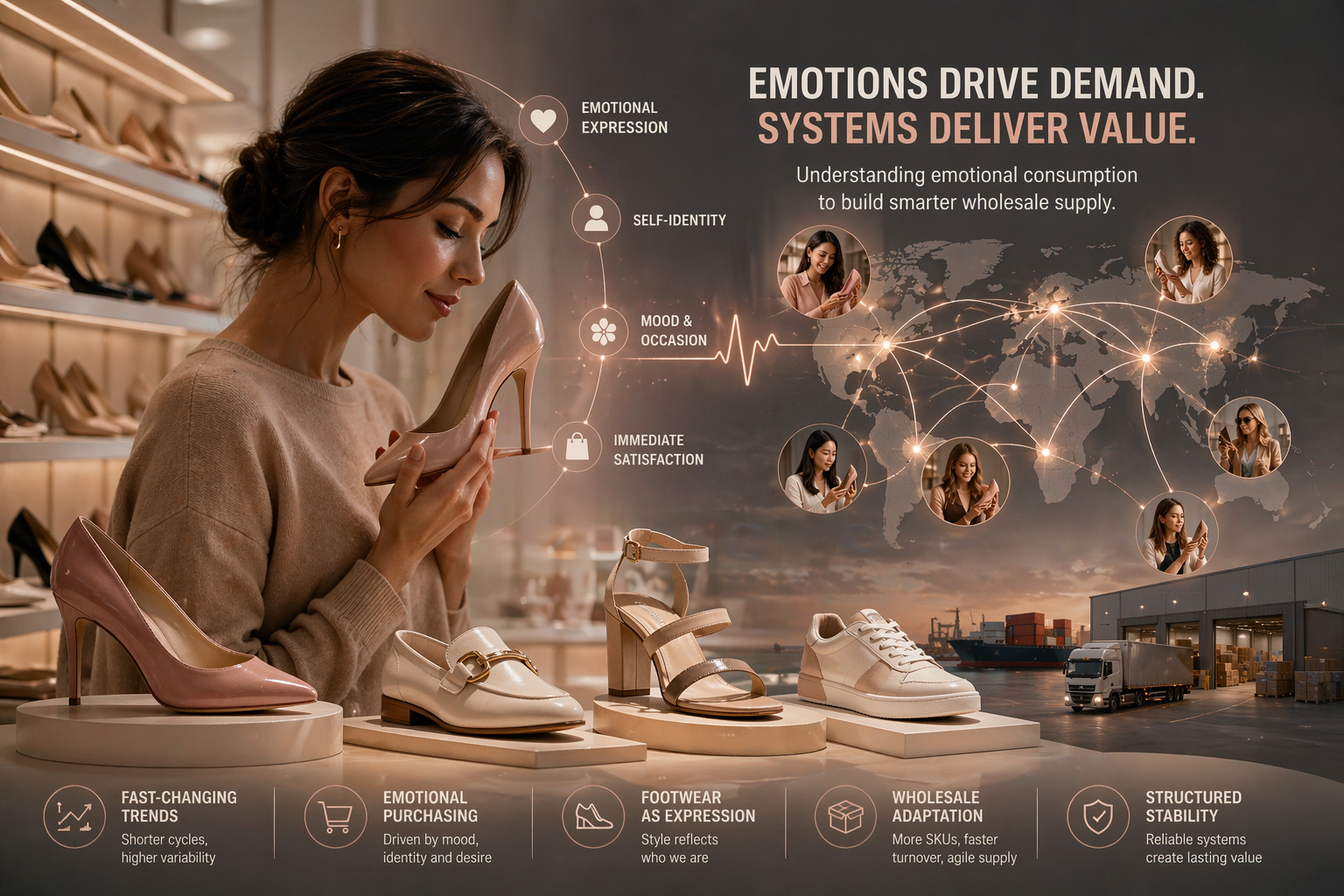
Emotional Consumption and Its Role in Footwear Wholesale Demand

Emotional Consumption and Its Role in Footwear Wholesale Demand

Apr 26, 2026

Emotional Consumption and Its Role in Footwear Wholesale Demand


In global footwear wholesale, demand has traditionally been analyzed through functional needs, seasonal cycles, and pricing structures.


However, in today’s increasingly volatile market environment, this perspective is no longer sufficient.


Consumer behavior is shifting.


Purchasing decisions are becoming more influenced by emotional and psychological factors rather than purely functional considerations.


For wholesale systems, understanding this shift is essential to maintaining relevance and competitiveness.


Market Volatility and Changing Consumer Behavior


Global markets are becoming more dynamic and less predictable.


Information flows faster, trends evolve more rapidly, and external uncertainties continue to shape consumer sentiment.


In such an environment, purchasing decisions are no longer based solely on long-term planning.


Instead, they are increasingly influenced by:


• short-term emotional response

• desire for immediacy and quick satisfaction

• need for personal expression

• search for stability in uncertain conditions


This shift creates a new layer of demand that operates alongside traditional consumption patterns.


From Functional Consumption to Emotional Demand
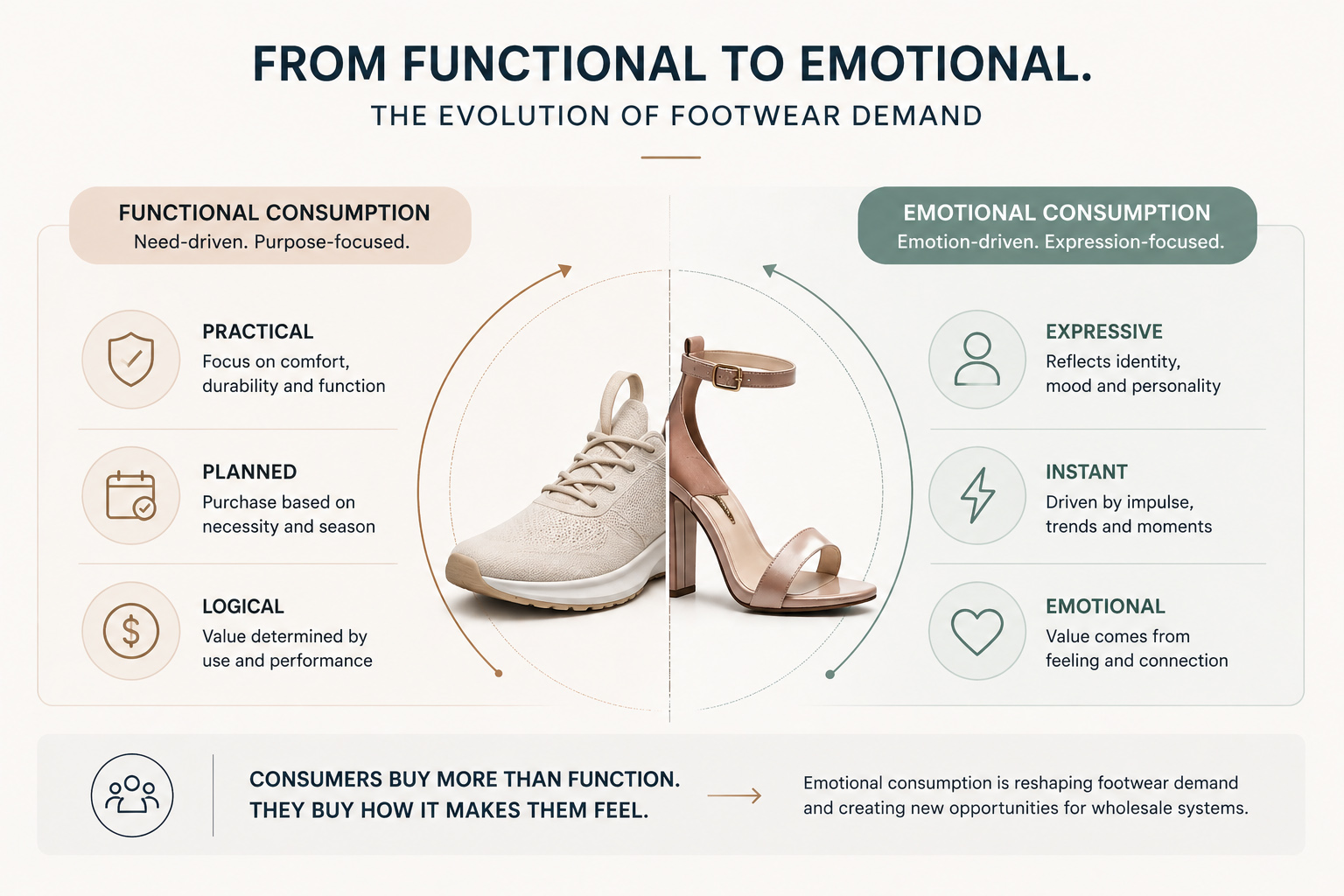
functional-vs-emotional-footwear-consumption.jpg

Footwear has historically been positioned as a functional product category.


Comfort, durability, and practicality have been primary decision factors.


However, in modern retail environments, footwear also serves additional roles.


It becomes:


• a form of self-expression

• a reflection of personal identity

• a tool for emotional adjustment

• a product aligned with mood and occasion


This transition does not replace functional demand — it expands it.


Wholesale systems must therefore adapt to serve both dimensions simultaneously.


Why Footwear Is Sensitive to Emotional Consumption


Compared to other product categories, footwear is particularly responsive to emotional demand.


Several structural characteristics contribute to this:


• relatively high purchase frequency

• wide variation in styles and price levels

• strong visual and identity-driven appeal

• balance between function and fashion


Unlike high-commitment luxury goods, footwear allows for more flexible and frequent purchasing decisions.


This makes it a key category in short-cycle, emotionally influenced consumption.


Implications for Footwear Wholesale Systems


The rise of emotional consumption introduces new requirements for wholesale operations.


Traditional models based on long cycles and static demand assumptions become less effective.


Instead, wholesale systems must adapt to:


• faster product turnover and shorter demand cycles

• increased SKU diversity

• more responsive inventory planning

• closer alignment with retail demand signals


At the same time, maintaining stability remains critical.


Without structured systems, increased demand variability can lead to operational instability.


Balancing Emotional Demand with Structural Stability


The challenge for wholesale systems is not simply responding to emotional demand.


It is doing so without sacrificing control.


Structured wholesale operations enable this balance by:


• maintaining consistency in production and supply

• coordinating batch-based dispatch with demand fluctuations

• aligning inventory allocation with market dynamics

• ensuring predictable execution despite changing demand patterns


In this way, emotional consumption does not create instability — it requires stronger systems to manage it.


Emotional Demand in a Fragmented Market Environment


In fragmented global trade conditions, external uncertainty is already present.


Emotional consumption amplifies this variability at the demand level.


Wholesale systems that are not structured may struggle to adapt.


However, those with coordinated systems can:


• absorb demand fluctuations

• maintain supply continuity

• respond to market changes without disruption


This transforms emotional demand from a risk into an opportunity.


Conclusion


In modern footwear wholesale, demand is no longer defined solely by function or price.


Emotional consumption has become an important driver of purchasing behavior.


For wholesale systems, the ability to understand and respond to this shift — while maintaining structural stability — is essential.


In increasingly dynamic markets, the most effective systems are those that combine responsiveness with control.


We use cookie to improve your online experience. By continuing to browse this website, you agree to our use of cookie.

Cookies

Please read our Terms and Conditions and this Policy before accessing or using our Services. If you cannot agree with this Policy or the Terms and Conditions, please do not access or use our Services. If you are located in a jurisdiction outside the European Economic Area, by using our Services, you accept the Terms and Conditions and accept our privacy practices described in this Policy.
We may modify this Policy at any time, without prior notice, and changes may apply to any Personal Information we already hold about you, as well as any new Personal Information collected after the Policy is modified. If we make changes, we will notify you by revising the date at the top of this Policy. We will provide you with advanced notice if we make any material changes to how we collect, use or disclose your Personal Information that impact your rights under this Policy. If you are located in a jurisdiction other than the European Economic Area, the United Kingdom or Switzerland (collectively “European Countries”), your continued access or use of our Services after receiving the notice of changes, constitutes your acknowledgement that you accept the updated Policy. In addition, we may provide you with real time disclosures or additional information about the Personal Information handling practices of specific parts of our Services. Such notices may supplement this Policy or provide you with additional choices about how we process your Personal Information.


Cookies

Cookies are small text files stored on your device when you access most Websites on the internet or open certain emails. Among other things, Cookies allow a Website to recognize your device and remember if you've been to the Website before. Examples of information collected by Cookies include your browser type and the address of the Website from which you arrived at our Website as well as IP address and clickstream behavior (that is the pages you view and the links you click).We use the term cookie to refer to Cookies and technologies that perform a similar function to Cookies (e.g., tags, pixels, web beacons, etc.). Cookies can be read by the originating Website on each subsequent visit and by any other Website that recognizes the cookie. The Website uses Cookies in order to make the Website easier to use, to support a better user experience, including the provision of information and functionality to you, as well as to provide us with information about how the Website is used so that we can make sure it is as up to date, relevant, and error free as we can. Cookies on the Website We use Cookies to personalize your experience when you visit the Site, uniquely identify your computer for security purposes, and enable us and our third-party service providers to serve ads on our behalf across the internet.

We classify Cookies in the following categories:
 ●  Strictly Necessary Cookies
 ●  Performance Cookies
 ●  Functional Cookies
 ●  Targeting Cookies


Cookie List
A cookie is a small piece of data (text file) that a website – when visited by a user – asks your browser to store on your device in order to remember information about you, such as your language preference or login information. Those cookies are set by us and called first-party cookies. We also use third-party cookies – which are cookies from a domain different than the domain of the website you are visiting – for our advertising and marketing efforts. More specifically, we use cookies and other tracking technologies for the following purposes:

Strictly Necessary Cookies
These cookies are necessary for the website to function and cannot be switched off in our systems. They are usually only set in response to actions made by you which amount to a request for services, such as setting your privacy preferences, logging in or filling in forms. You can set your browser to block or alert you about these cookies, but some parts of the site will not then work. These cookies do not store any personally identifiable information.

Functional Cookies
These cookies enable the website to provide enhanced functionality and personalisation. They may be set by us or by third party providers whose services we have added to our pages. If you do not allow these cookies then some or all of these services may not function properly.

Performance Cookies
These cookies allow us to count visits and traffic sources so we can measure and improve the performance of our site. They help us to know which pages are the most and least popular and see how visitors move around the site. All information these cookies collect is aggregated and therefore anonymous. If you do not allow these cookies we will not know when you have visited our site, and will not be able to monitor its performance.

Targeting Cookies
These cookies may be set through our site by our advertising partners. They may be used by those companies to build a profile of your interests and show you relevant adverts on other sites. They do not store directly personal information, but are based on uniquely identifying your browser and internet device. If you do not allow these cookies, you will experience less targeted advertising.

How To Turn Off Cookies
You can choose to restrict or block Cookies through your browser settings at any time. Please note that certain Cookies may be set as soon as you visit the Website, but you can remove them using your browser settings. However, please be aware that restricting or blocking Cookies set on the Website may impact the functionality or performance of the Website or prevent you from using certain services provided through the Website. It will also affect our ability to update the Website to cater for user preferences and improve performance. Cookies within Mobile Applications

We only use Strictly Necessary Cookies on our mobile applications. These Cookies are critical to the functionality of our applications, so if you block or delete these Cookies you may not be able to use the application. These Cookies are not shared with any other application on your mobile device. We never use the Cookies from the mobile application to store personal information about you.

If you have questions or concerns regarding any information in this Privacy Policy, please contact us by email at . You can also contact us via our customer service at our Site.